 GHL Command
The board and the work queue
Know where every client stands before you open GoHighLevel.
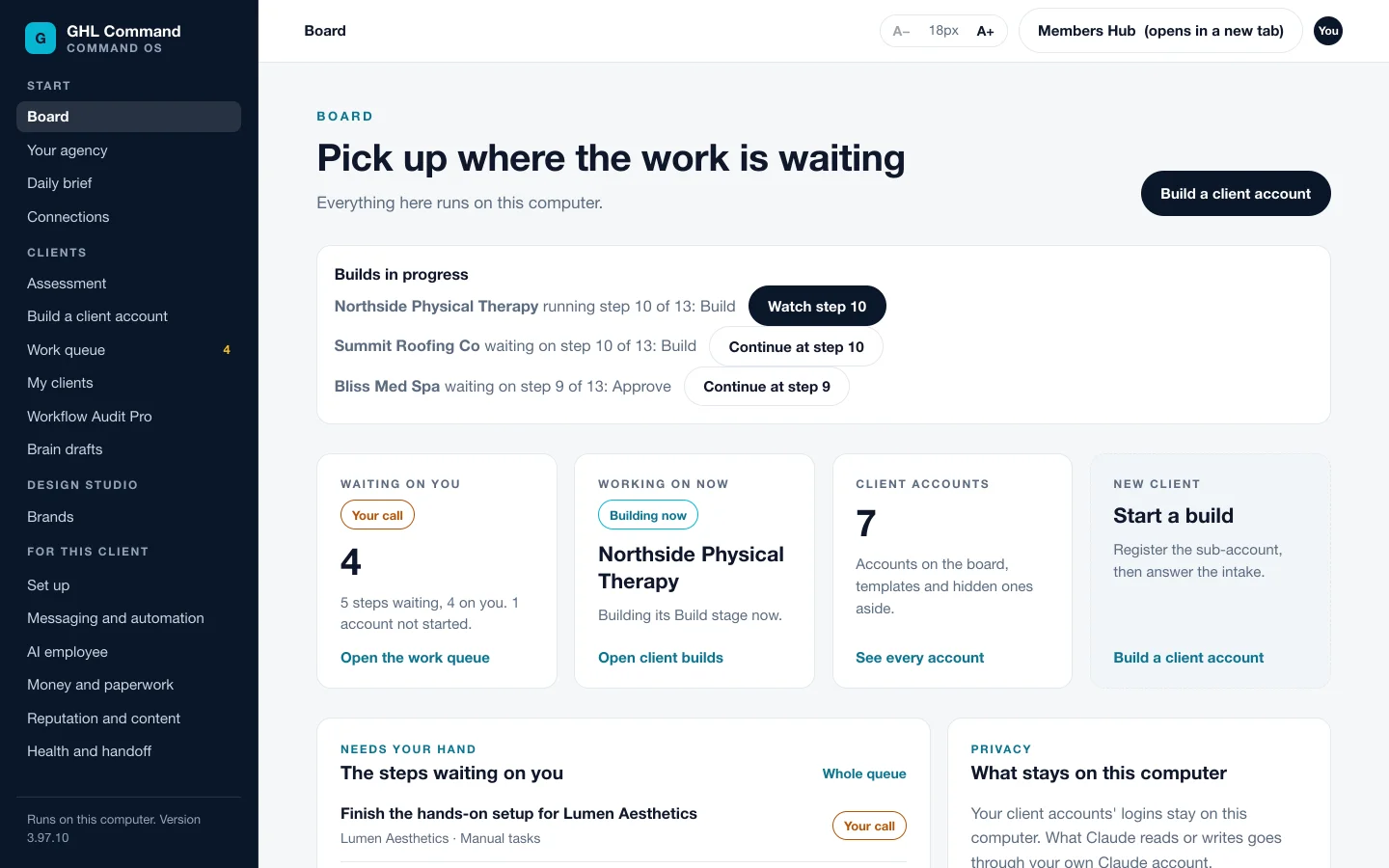
Every client account you register on one board. One row per job: the client, the step, and whether it needs you.
Command OS and GHL Command, for GoHighLevel agencies
Command OS puts every GoHighLevel client account you register on one board, with a daily brief, logins for your team, and the tools to sell the next client. Claude does the building, from a plan you approve.
Command OS is $497 a month. The first 20 paying members pay $297 a month for as long as they stay subscribed. Prefer to start smaller? GHL Command is $97 a month. Neither plan is billed per sub-account.
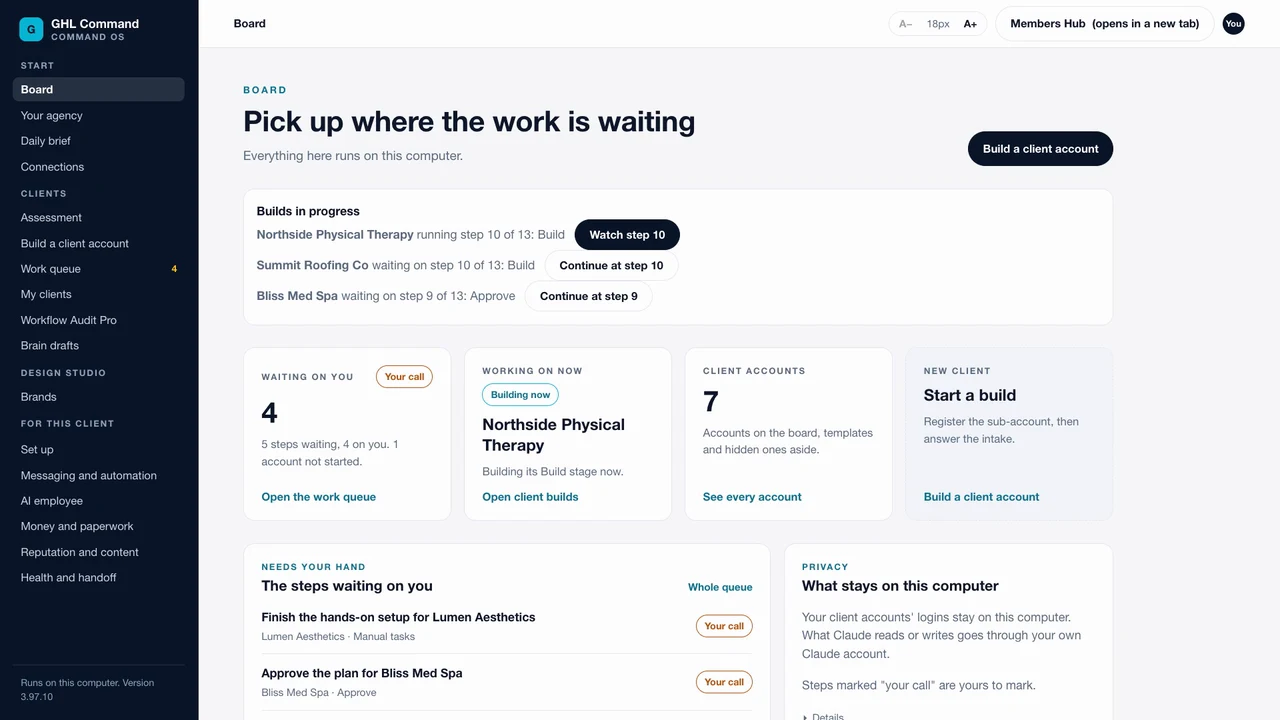
A screen recording of the real cockpit, made November 12, shown with example clients. None is a customer account. The voiceover is an AI voice; captions are in the player.
What it is
GHL Command connects Claude to GoHighLevel, so you describe a job in plain words and Claude does it inside the client's sub-account. It includes the cockpit for one client at a time. Command OS puts every client on one board, your team under their own logins, and a brain on each client that drafts replies for a person to approve. Both run on your own computer, with your own GoHighLevel keys.
A demo chat bot (in beta) a prospect can text, an Assessment built from their own numbers, and reports with your agency's name on them. In both plans.
See the selling tools → 02Pipeline, calendar, form, fields and workflows, built by Claude from a plan you approve. A check then reads the account back.
See how a build runs → 03One board, one work queue and one daily brief across every client. A team that can do the work without waiting on you.
See the cockpit →01 · Win the client · Both plans
“We do AI and automation” sounds like every other agency that called them this month. Open the first conversation with something the prospect can see, and close it with a document in your brand.
A screen recording of the real cockpit, version 3.97.12, shown with an example agency and an example prospect. Neither is a customer, and the figures are example data. The voiceover is an AI voice.
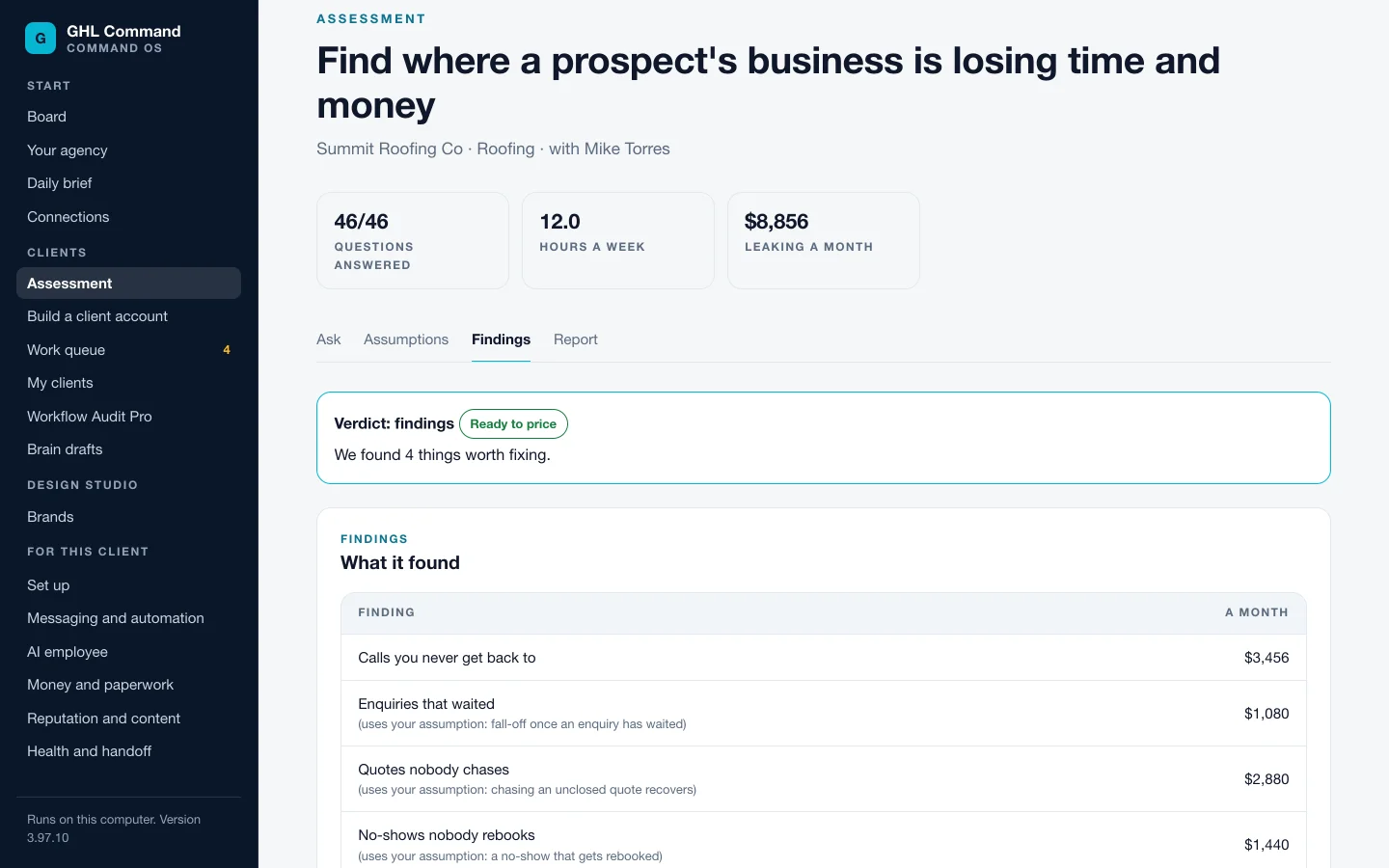
THE ASSESSMENT
Run the Assessment with a prospect from the cockpit. It turns their answers into findings with a monthly figure and hours a week, worked out from numbers they gave you. It lands in your own GoHighLevel: the prospect as a contact, the answers as a note, the deal on an Assessments pipeline.
When they sign, attach it to their build. The intake fills in from it, so the build starts from what was sold.
REPORTS IN YOUR BRAND
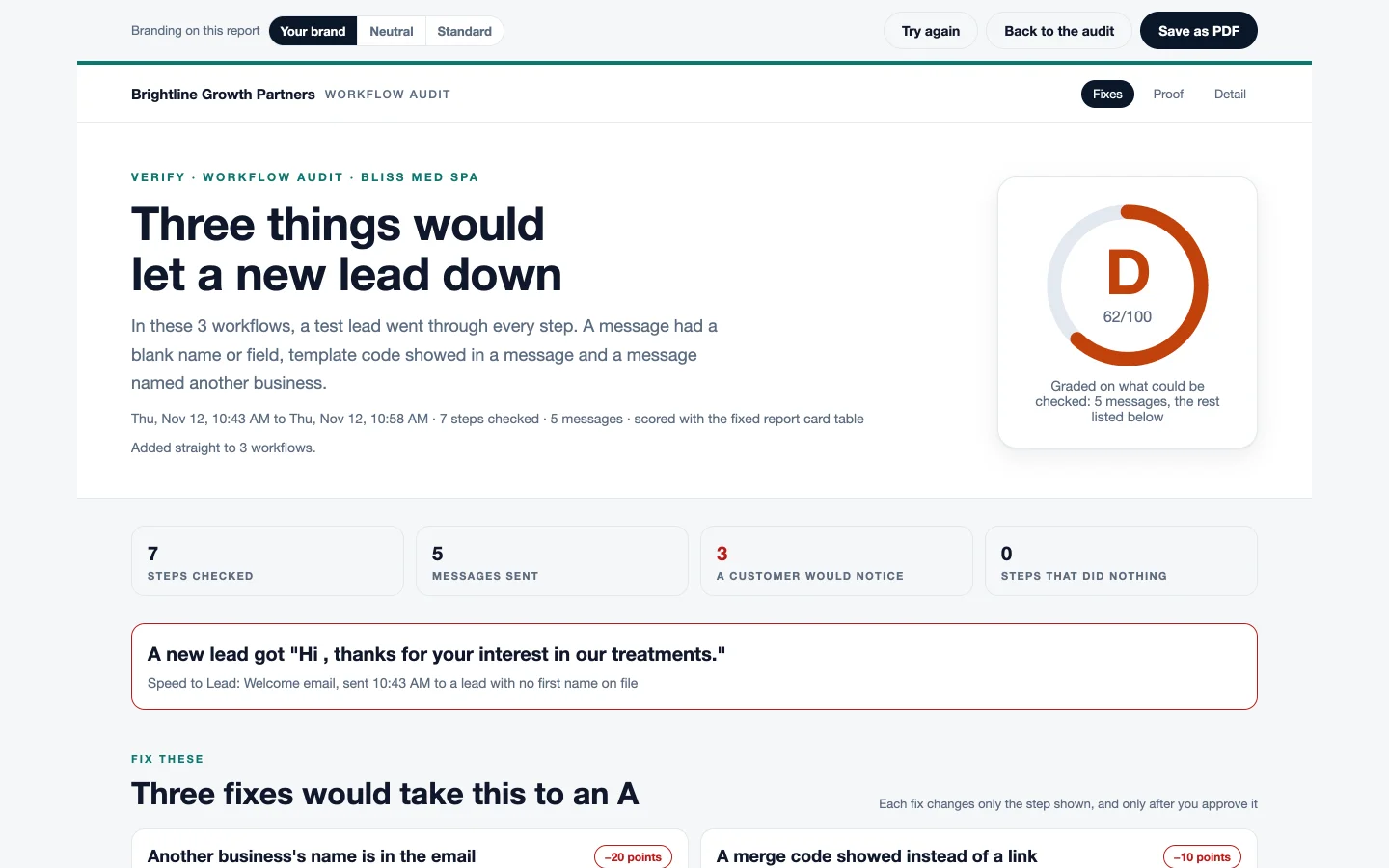
Fill in your agency once: name, logo, brand colour, contact details, offers. The Assessment report, the audit report Beta and the client handoff then carry your brand. A saved PDF names no product.
Workflow Audit Pro sends a test lead through a client's account and reads back every text and email, word for word. Have the workflow audit written up for the person paying the bill, and you have an audit you can charge for.
The demo chat bot needs a demo sub-account with a phone number, A2P approval and GoHighLevel's AI Employee switched on, which GoHighLevel bills separately.
02 · Build the account · both plans
The same pipeline, fields and follow-ups, rebuilt by hand for every new client, is the job this takes. Blueprint plans the build and waits for your approval. In the cockpit, the same build runs as thirteen numbered steps, one client at a time on GHL Command. On Command OS, a team member can run it under their own login and you sign it off.
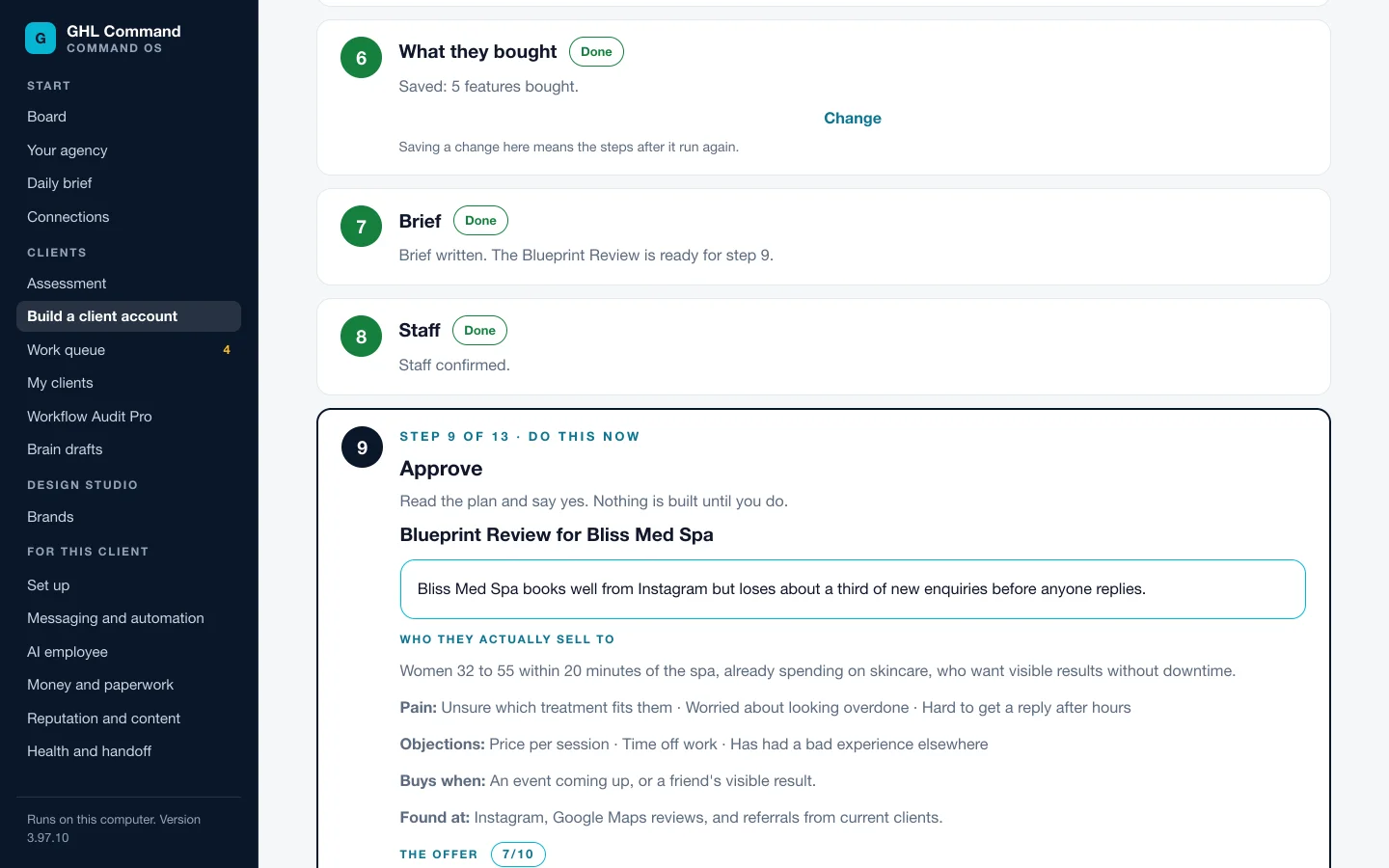
THIRTEEN NUMBERED STEPS · IN THE COCKPIT
Someone fills in the intake and what the client bought. Claude writes the plan. You approve it. Every automation lands as a draft. A check reads the account back and says what GoHighLevel confirms, and the last step is your sign-off.
By hand, a small account build takes Jerry about 6 hours, and a med spa build 10 to 12.
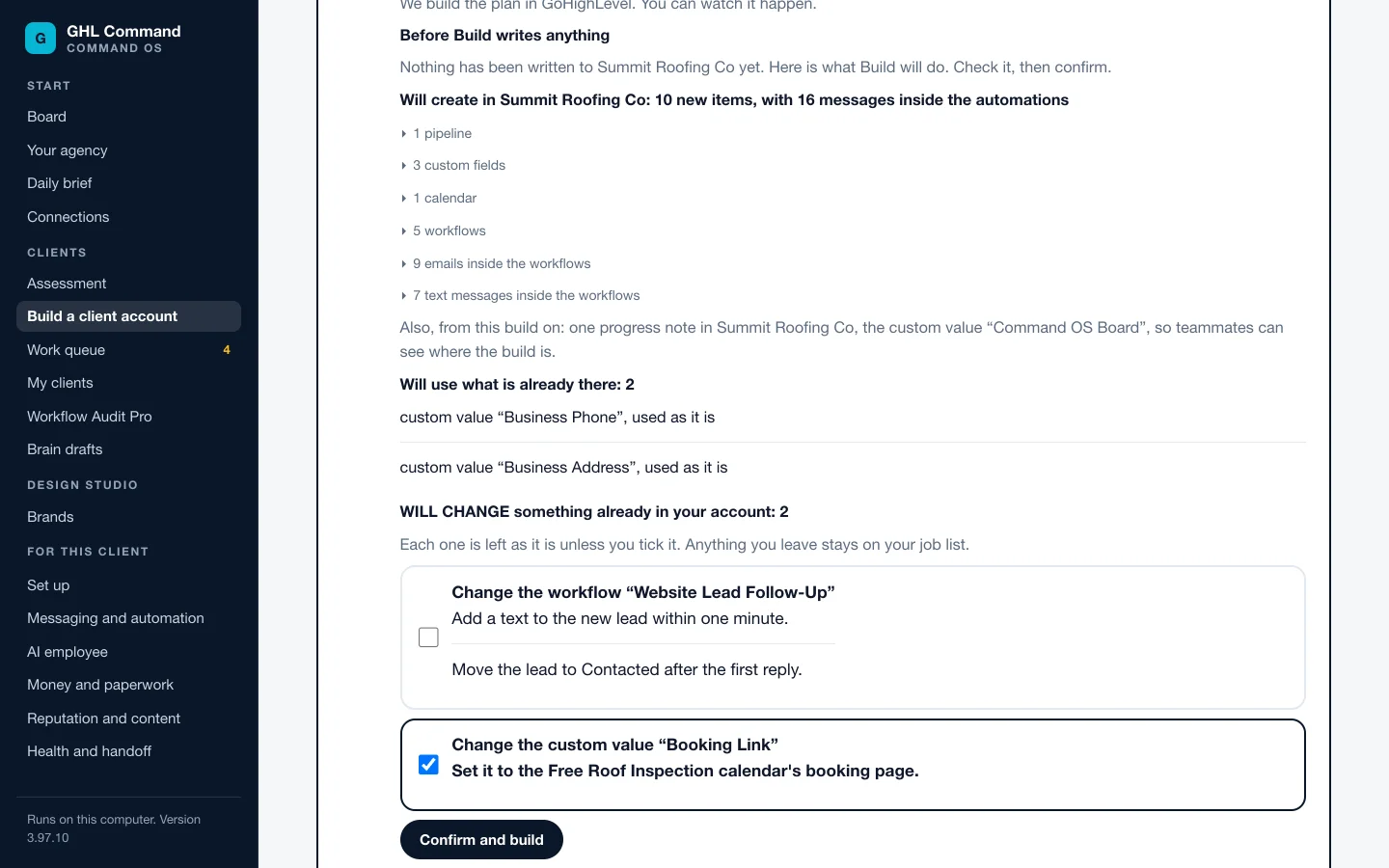
NOTHING WRITTEN BLIND · IN THE COCKPIT
What it will create, what it will use, and what it would change. Then it waits for you. You can watch the build happen or leave the page, and the step lists everything it made.
The read-only workflow audit can be your first job: it reads every workflow in an account and ranks the steps that point at something that no longer exists. It changes nothing.
A step that points at a deleted stage or field doesn't warn anyone. GoHighLevel skips it, and every step after it.
Our read-only check of all 23 of our own GoHighLevel accounts, September 1, 2026. The repairs were our own work.
03 · Run the agency · Command OS
The hard part is knowing which client needs you this morning, and getting the fix done without every change waiting on you. Command OS is built so the work can leave your hands.
Every client account you register on one board. One row per job: the client, the step, and whether it needs you.
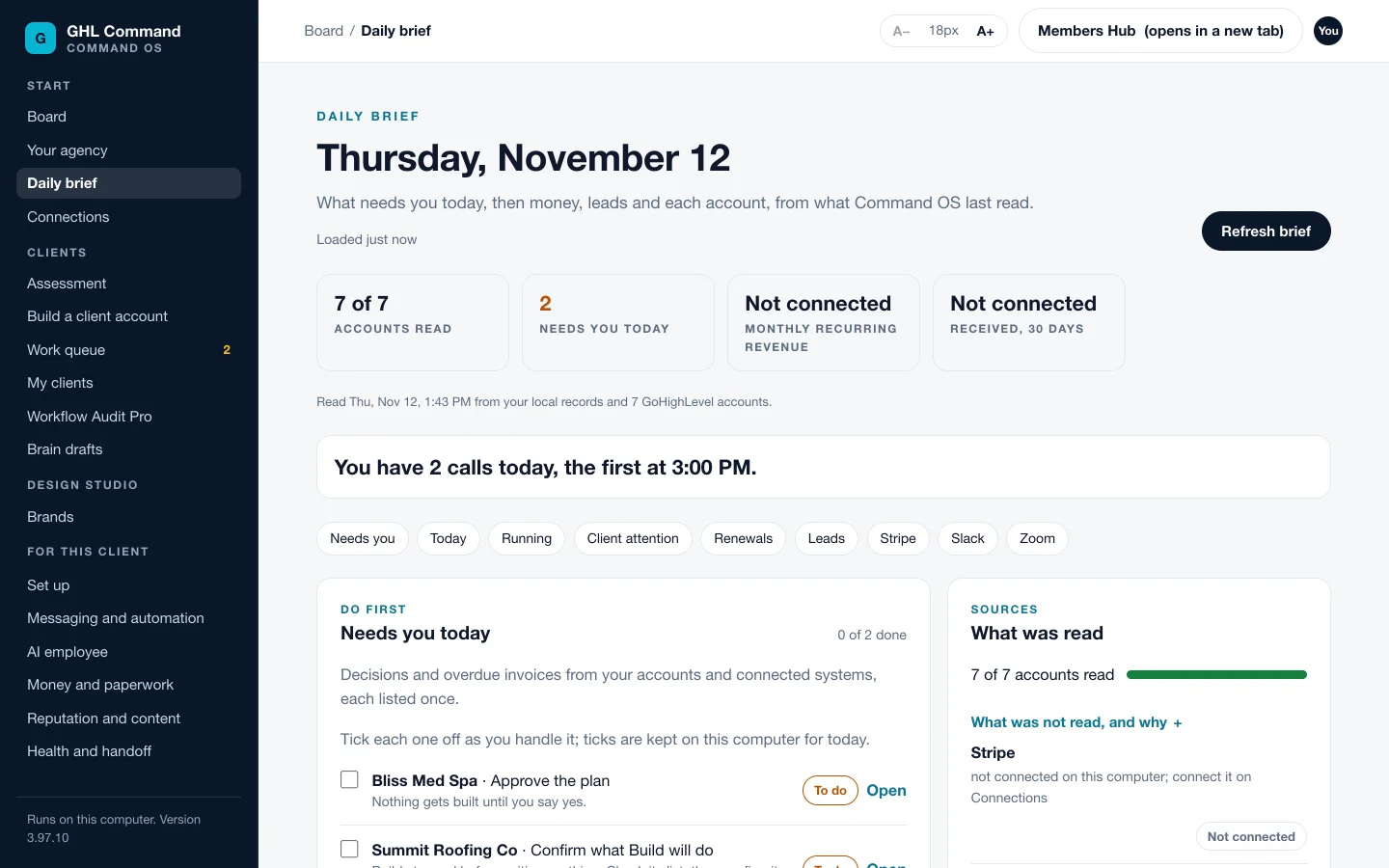
Appointments, what is waiting on you, renewals inside 30 days and new leads since midnight, for every registered client at once.
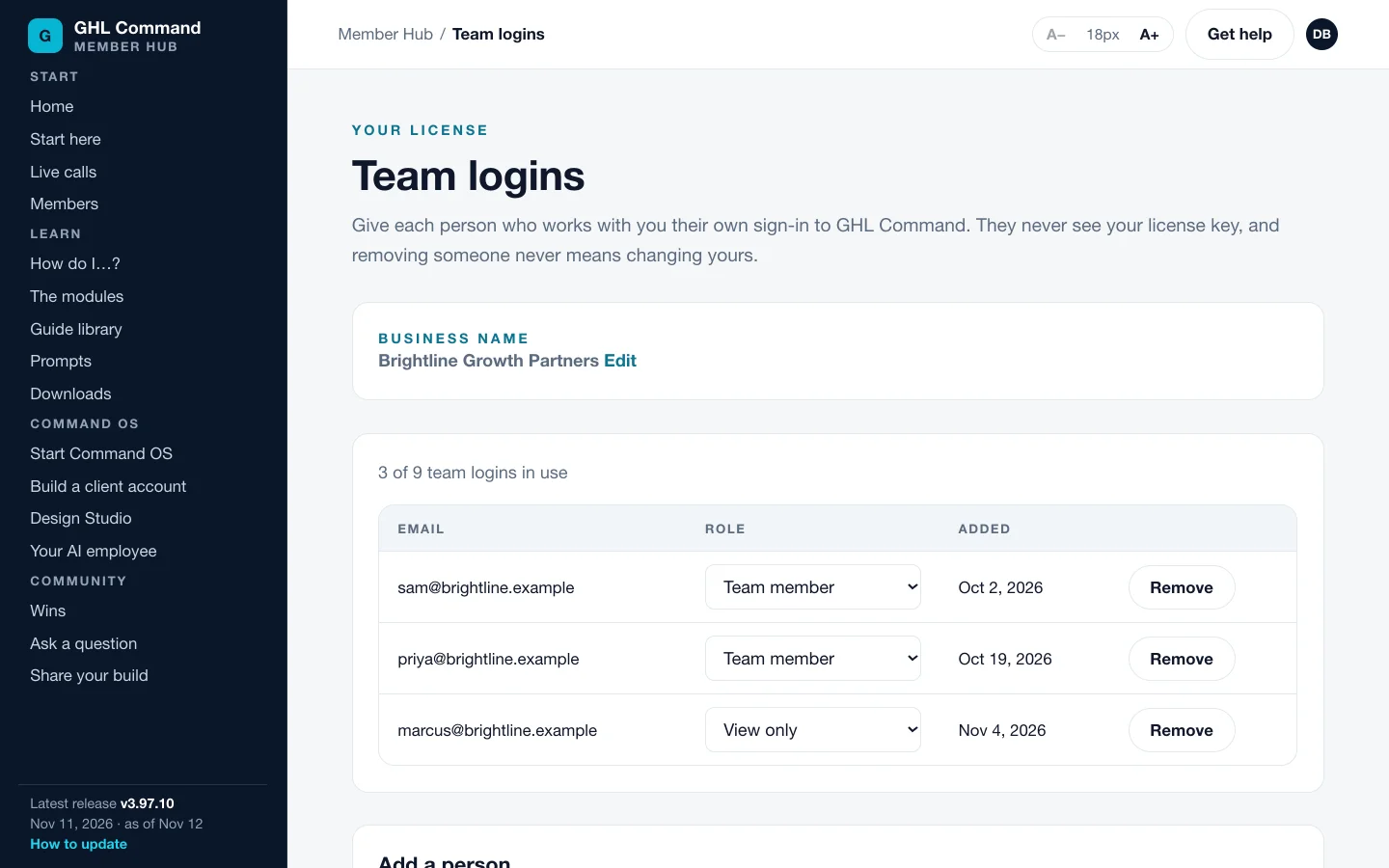
Up to 9 team members, each with their own login, 10 computers in total. Full access or view only. Remove someone and your own key stays as it is.
It keeps a small memory of each client: which leads booked, which opted out, which need a person. It drafts replies for a person to read and approve. It does not send messages on its own. See how the brain works
In beta: the client brain, the demo chat bot and Design Studio. They are released and you can use them today. We are still testing and improving them, so they may change. Everything else on this page is fully released.
The Client Brain · Command OS · Beta
Most AI follow-up starts from zero every time. It does not know the lead booked yesterday, that they texted STOP last week, or that this client never discusses price by text. That is how an agency loses a client in one message.
The Client Brain keeps one small memory for each client you run in GoHighLevel. Before anything is written to a lead, it knows the lead.
Your existing workflows, made safer
Add the brain's check to a workflow you already run. It answers right before the message goes, and holds anything that should not reach this lead today. You see the exact workflow and the step before you say yes.
Stop means stop
The brain records the stop and turns on do-not-disturb in GoHighLevel, then logs it so you can see who, when and why. It never drafts a nudge to someone who said STOP.
Every client on one screen
Which clients have drafts waiting more than a day? Which have a lead held for a person? Which have facts waiting for approval? It shows counts and times only, and keeps each client's messages apart.
| Typical second-brain tool | The Client Brain | |
|---|---|---|
| Who it remembers | You and your notes | Each client, and each of their leads |
| Where the data lives | Usually on the tool maker's servers | In your own Supabase account. Never ours. |
| Knows who asked to stop | No | Built to, and turns on do-not-disturb in GoHighLevel |
| Works inside GoHighLevel | Copy and paste | Hears replies and bookings, and answers your workflows |
| Where facts come from | Whatever was typed or guessed | A source on every fact, approved by a person |
| Changes it makes | Whenever it decides to | Only after you see the plan and say yes |
| AI cost | Bundled, out of your control | Your own Anthropic key, with limits you set |
Every client costs more
One flat price
GoHighLevel's prices are from its “AI Product Pricing” article, last modified November 10, 2026. Our flat price covers our tools, on as many sub-accounts as you run. It does not replace what others bill you: a chat bot or phone agent you build still runs on that client's GoHighLevel AI Employee, which GoHighLevel bills, and Anthropic bills your Claude account.
Watch
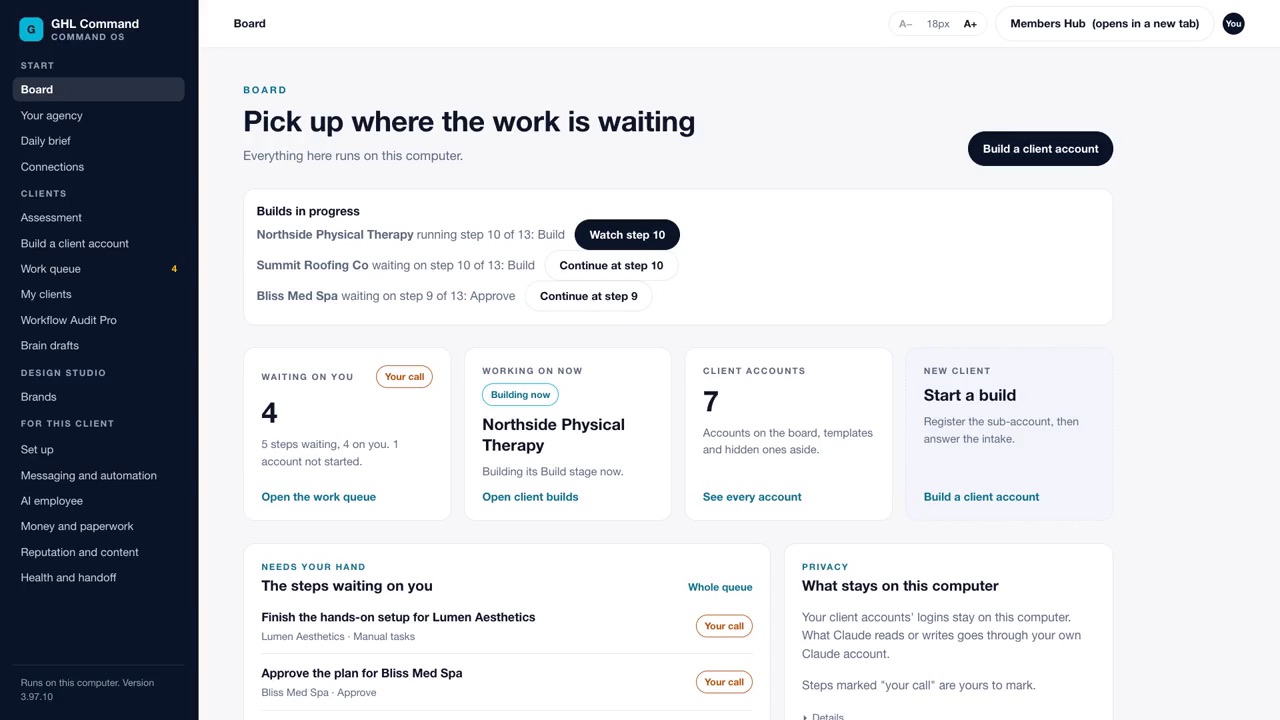
The Board, My clients, the work queue and the daily brief.
Recorded November 12 in the real cockpit, with example clients. None is a customer account. The voiceover is an AI voice; captions are in the player.
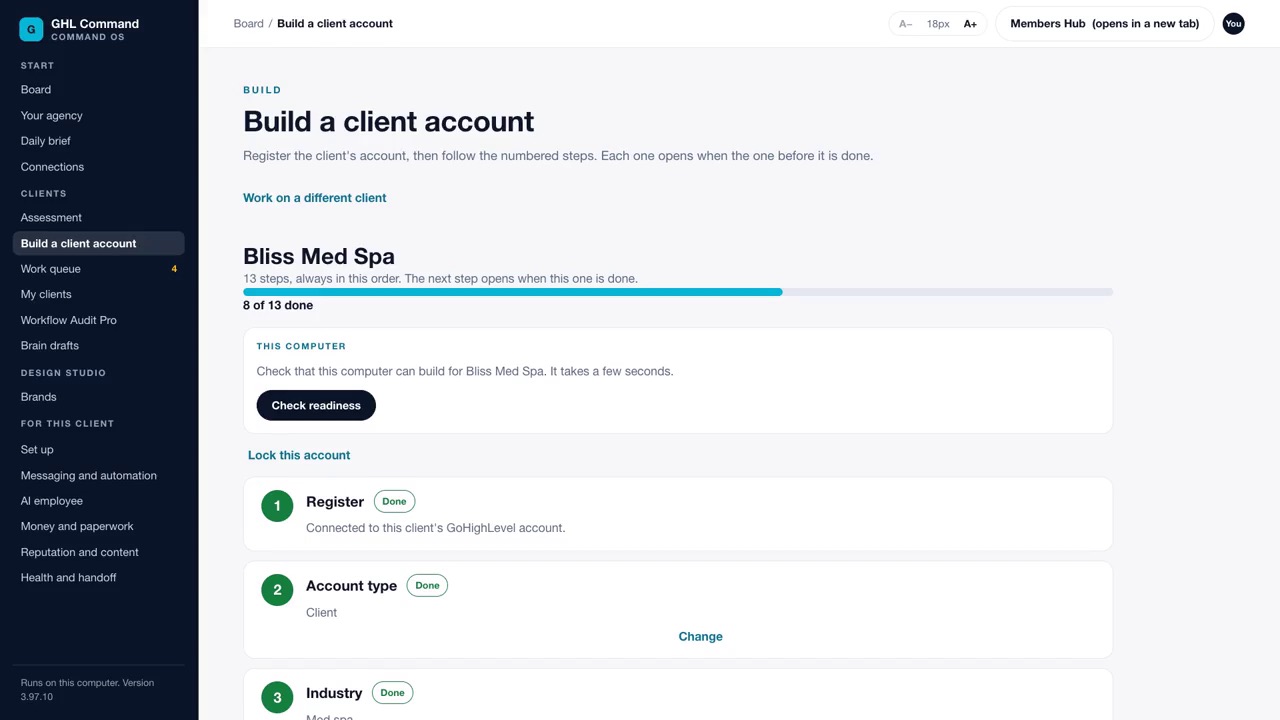
A client build in the cockpit, from the plan to the list shown before anything is written.
Recorded November 12 in the real cockpit, with example clients. None is a customer account. The voiceover is an AI voice; captions are in the player.
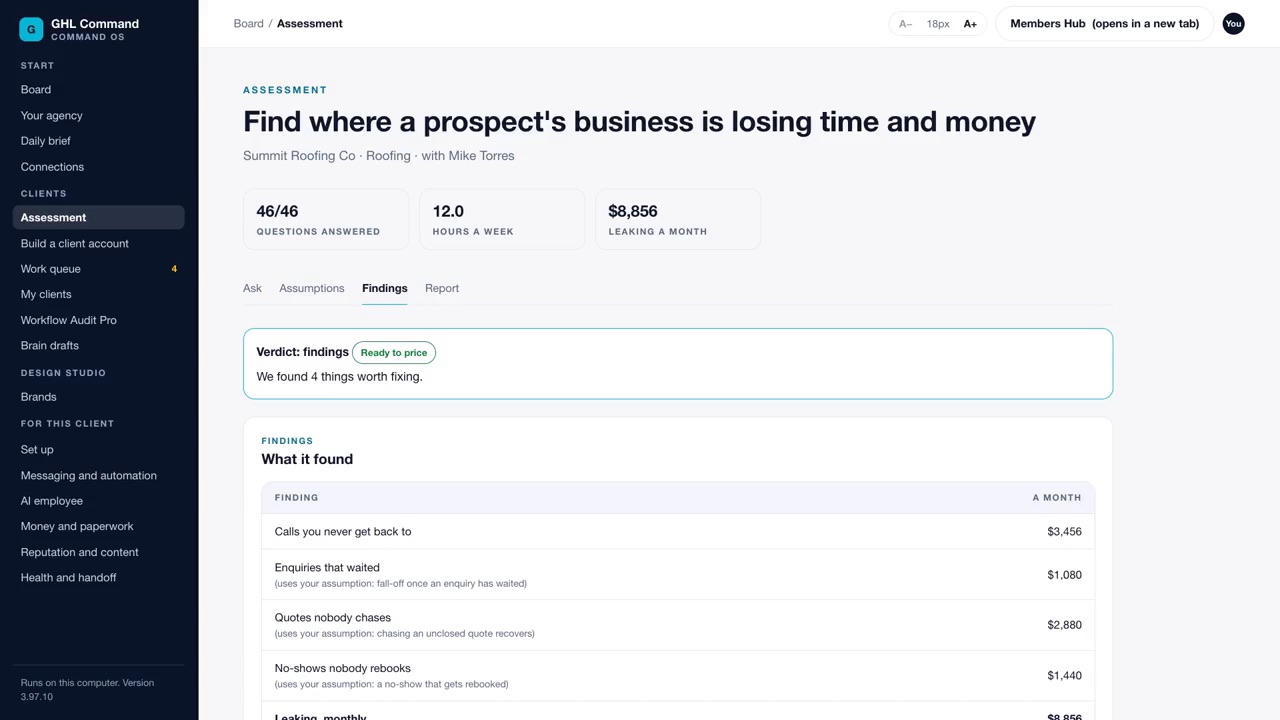
The Assessment and Workflow Audit Pro.
Recorded November 12 in the real cockpit, with example clients. None is a customer account. The voiceover is an AI voice; captions are in the player.
The board, a client build in thirteen steps, the work queue, the daily brief, the Assessment and Workflow Audit Pro.
Recorded November 12 in the real cockpit, with example clients. None is a customer account. The voiceover is an AI voice; captions are in the player.
Ask in plain words. Claude does the work in the sub-account and tells you what it did.
The same tools in Claude Code, for the days you want to move fast.
Screens and numbered steps in your browser instead of a conversation. One client at a time on GHL Command, every client on Command OS. It runs on your own computer.
The Members Hub · both plans
Every member gets the Members Hub: guides sorted by the job in front of you, a “How do I” finder, prompts you paste straight to Claude, and the Command OS instructions.
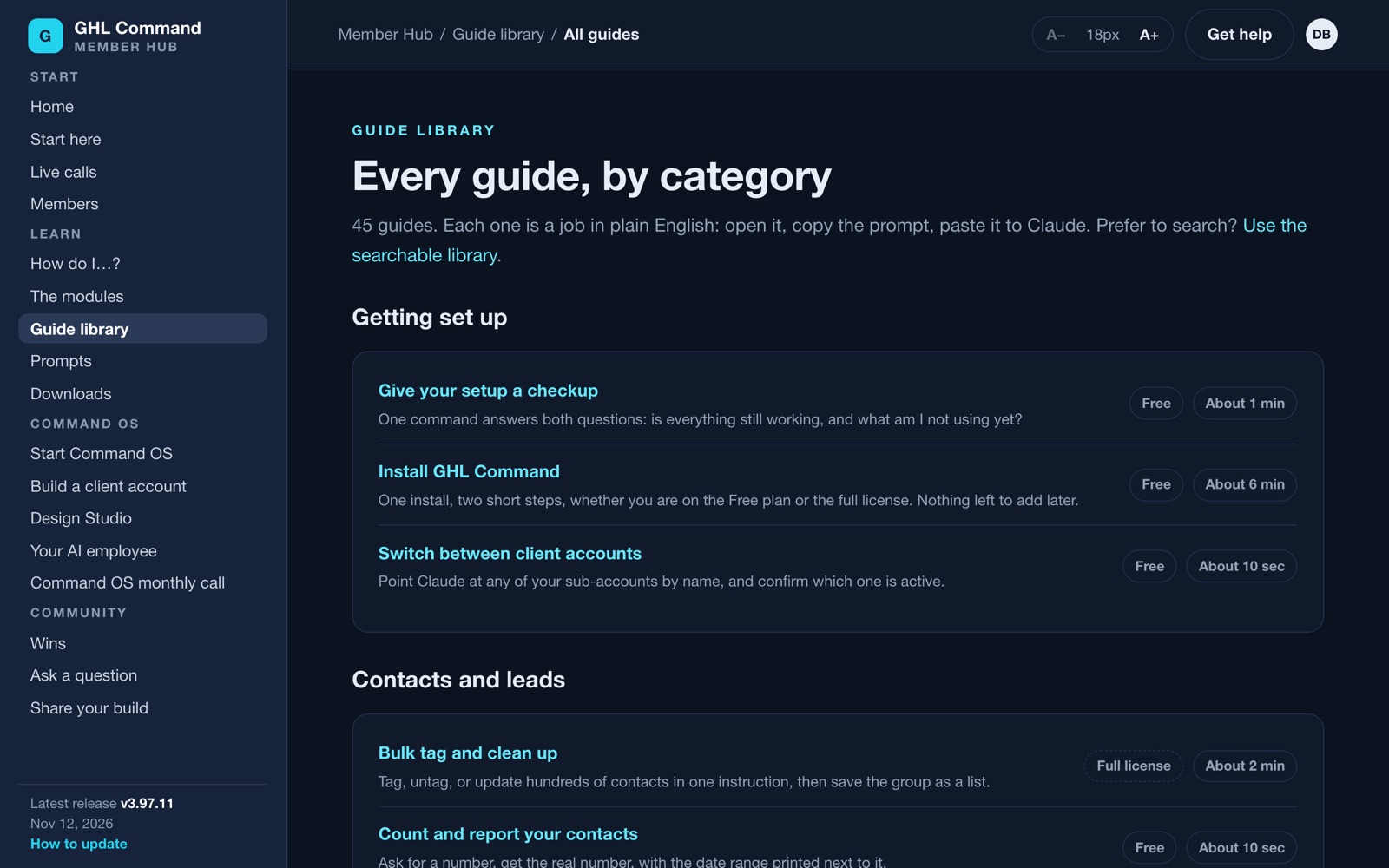
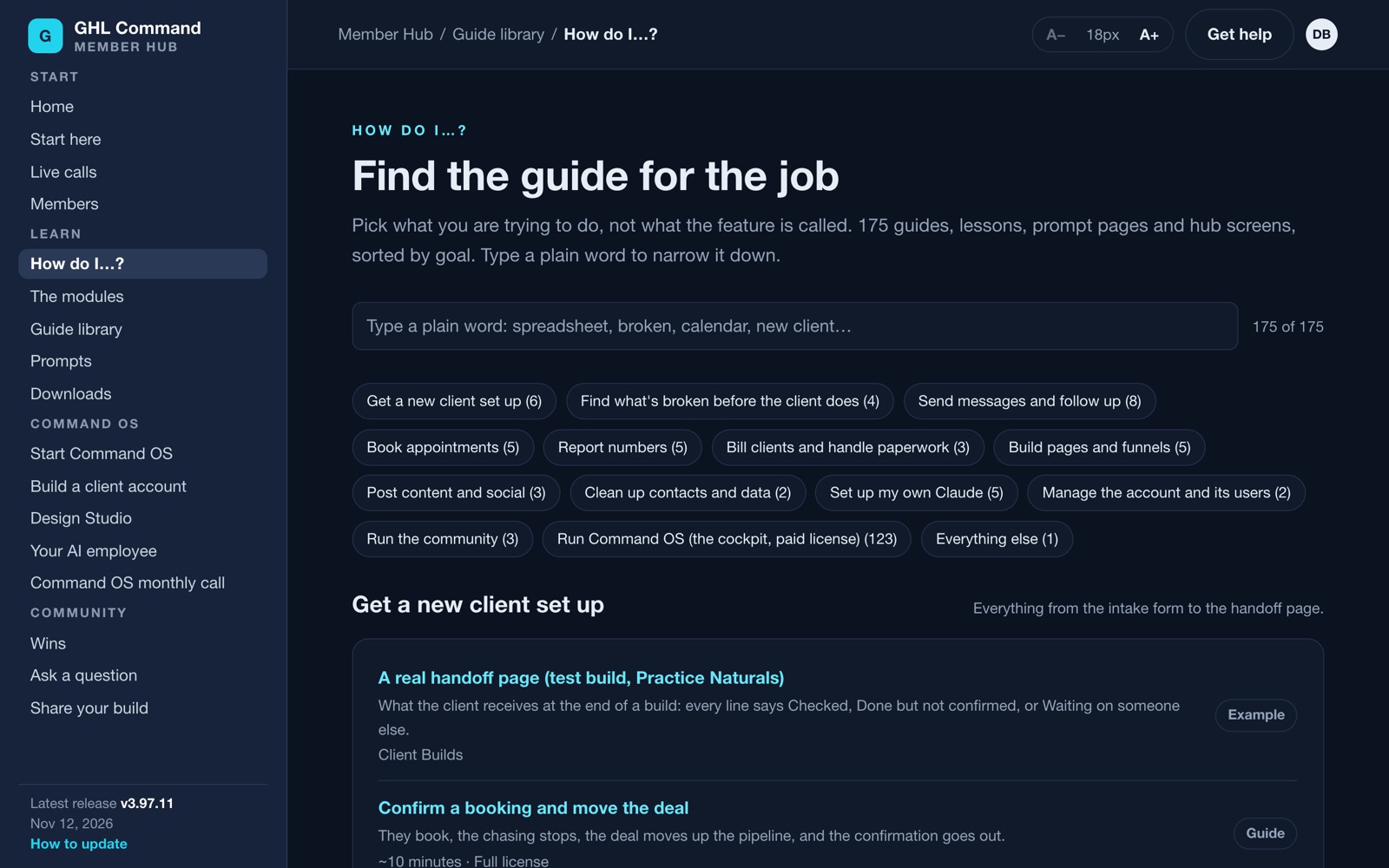
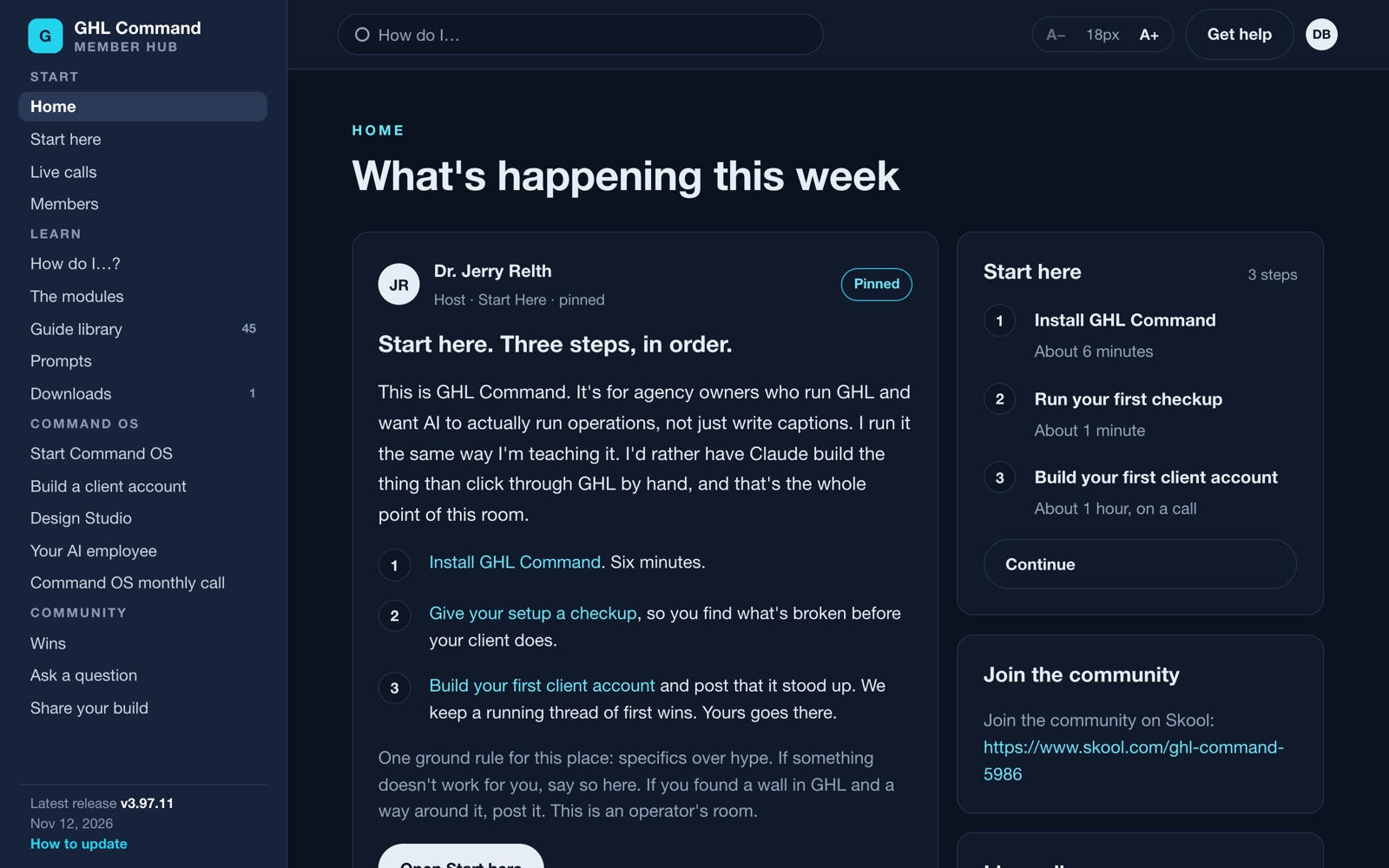
The Members Hub at version 3.97.11, captured November 12 from a local copy and shown as an example member.
Members

“With GHL Command, I can get my Claude Code to do almost anything for me in GoHighLevel.”
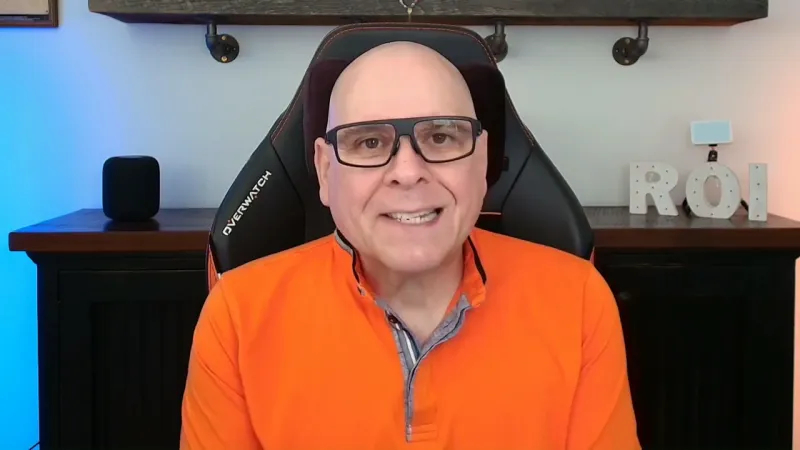
“It takes everything GoHighLevel can do and puts it one sentence away, instead of buried five clicks deep.”
“I've already set it up, I'm using it and it works perfectly.”
“That worked. Thank you.”
Plans
GHL Command lets Claude win and build one client at a time, in chat or in the cockpit. Command OS adds the board across every client, the client brain and team logins, for an owner whose client list is long.
$297 a month for the first 20
paying members, then $497
$37 today for 7 days, with everything Command OS includes. On day 8 it becomes $297 a month if you hold one of the 20 Founders spots, or $497 a month otherwise. Your first full Command OS month comes with a 30-day refund.
$97 a month
$97 today, then $97 a month until you cancel. Your first full month comes with a 30-day refund. Or try it 7 days for $7, then $97 a month from day 8 unless you cancel.
| GHL Command | Command OS | |
|---|---|---|
| Where you work | A Claude chat, plus the cockpit for one client at a time | The same chat, plus the cockpit across every client account you register |
| Finding what needs you | A daily brief for the one client you pick | One board, one work queue and one daily brief across every client account you register |
| A new client build | Thirteen numbered steps on one page, with a check that reads the account back, one client at a time | The same build, which a team member can run under their own login, with your sign-off Beta |
| Winning a client | The Assessment, a report on a prospect's website, and a demo chat bot (in beta) the prospect can text | The same |
| Client brain Beta | Not included | Included |
| Who can log in | You, on up to 3 computers | You plus up to 9 team members, 10 computers in total |
| Monthly group call | Not included | Included |
| Price | $97 a month | $497 a month. The first 20 paying members pay $297. |
Your numbers
This is an example with round numbers, not a promise. Drag every number to yours.
From your numbers
20 hours
a month moved off your desk, if your guess is right
How it is worked out: hours a week times 4 weeks; hours times each rate; builds times your fee. It assumes the hours you hand over go to work you would bill or sell. Nobody can promise that. These are your own sums.
Month to month, on both plans
Email [email protected] within 30 days of your first full monthly payment and we refund that payment in full.
The 30-day refund covers monthly plans. A refund ends your membership right away. The $7 trial fee is not refunded. Read the terms.
Who is behind it

Dr. Jerry RelthElite DCS LLC. Maker of GHL Command and Command OS.
We checked all 23 of our own GoHighLevel accounts before we asked you to check yours.
“The product is amazing and I use it all of the time. But the man behind the product is just as amazing.”Muhammad Asmal, creator of Agency OS, in his video
Questions
GHL Command connects Claude to GoHighLevel so it can build pipelines, custom fields, tags, calendars, forms and workflows inside your client sub-accounts, from a plan you approve. It is for working one client at a time and costs $97 a month. Command OS includes everything in GHL Command and adds the board, the work queue and the daily brief across every client account, the client brain, logins for up to 9 team members and a live group call each month. It costs $497 a month, or $297 a month for the first 20 paying members.
No. GHL Command stays on sale at $97 a month, and it keeps getting upgrades. Command OS is a second plan with more tools, for owners with a long client list or a team.
No. Both plans are one flat monthly price with unlimited sub-accounts. We never bill per sub-account, per client or per build. GoHighLevel bills its own plan and features separately, and Anthropic bills your Claude account.
Both plans give you things a prospect can see: an Assessment that turns their own answers into priced findings and a report in your brand, a demo chat bot (in beta) they can text, a one-page report on their website, and an audit of an account written up for the person paying the bill.
A client build shows you the plan and waits for your approval. In the cockpit, before it writes anything, it shows what it will create, use and change, automations land as drafts, and a check reads the account back. Outside a build, Claude can carry out what you ask, including publishing a workflow, so ask for a plan first when a change matters.
On Command OS, yes: up to 9 team members with their own logins, on 10 computers in total, with full access or view only. GHL Command has no team logins; it runs on up to 3 computers on your key.
No. The client brain is in beta. It drafts replies as notes for a person to read and approve. It does not send messages on its own, and it is built to skip anyone who said STOP.
Yes. GHL Command has a 7-day trial for $7, then $97 a month from day 8 unless you cancel. Command OS starts with a 7-day trial for $37 with everything it includes. One trial per person.
A GoHighLevel plan with API access, which means Unlimited at $297 a month or higher, and your own Claude account. The cockpit needs Claude Code on the same computer. The client brain needs your own Supabase account (we recommend Supabase's Pro Plan: Supabase pauses Free Plan projects after a week without use, and a paused brain stops drafting replies) and your own Anthropic key, with a monthly cap you set.
HighLevel's MCP server is a good way to reach GoHighLevel from many AI apps. Command OS is your agency's own system for selling, building, running and checking client accounts, on top of GoHighLevel. You can use both. See GoHighLevel with Command OS, compared.
Your GoHighLevel keys stay on your computer and are never sent to us. What Claude reads goes to Claude, as with any Claude tool. We receive license checks and anonymous counts of installs and tool use, and you can switch the counts off. The client brain's memory is kept in your own Supabase account.
Two plans, one flat price each
Try Command OS for 7 days for $37, or start with GHL Command at $97 a month.
Or try GHL Command for 7 days for $7.
Neither plan is billed per sub-account. Needs GoHighLevel's $297 a month plan or higher.